Process and Principle

The ability to rapidly build and sustain Rapport is essential for those of us who need to Influence in our professional or private lives. We are also required to be ‘master rapport builders’ if we are to avoid or reduce conflict, particularly if our personal success is bound to the quality of the trusted relationships we develop. This ability can be intuitive for some but very challenging for others.
Whether we are ‘managing or motivating, selling or strategising, merging or marketing’, we need to influence everyone with whom we interact. What we are seeking is not hierarchical obedience to leadership, nor is it blind agreement to wacky ideas, but fully cognitive and emotionally energised commitment. Gaining that agreement is the process of persuasion, achieving the emotional “Buy in” is the effect of influence.
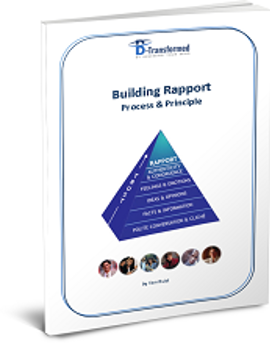
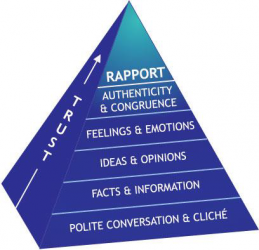
Getting to rapport is a stage process described in the The Rapport Pyramid™ below. All of us will be at different stages with the different people in our personal and professional lives.
The Rapport Pyramid ™
Communication Sequence
Stage # 1
Polite conversation & cliché…
Something the English are very good at, the main topic being the weather. It sometimes doesn’t even involve eye contact or listening, often expressed via the mouth without troubling the brain. Topics are ‘safe’ and often concluded with a cliché e.g. ‘all’s well that ends well!’ Rapport at this stage is far off.
Stage # 2
Facts & Information…
This usually employs some degree of listening and thought process but tends to involve ‘reporting’ facts & information rather than ‘communicating’. These facts can be delivered quite dispassionately, often via a series of statements with little need to involve personal conviction. Rapport is still far off; however, we are beginning to reveal the building blocks of what may be important to us.
Stage # 3
Ideas & Opinions…
Stage # 4
Feelings & Emotions…
Now we are involving our ‘soul’ which is our ‘Thinker’, ‘Chooser’ & ‘Feeler’. By expressing how we feel and displaying our emotions via the words we use, our tone of voice, our body language and pace, we are signaling: “this is how I really feel; these are the choices I have made and conclusions I have come to. I am hearing and responding to what you say (although my perception may be something different and I may be reacting rather than responding).” If this matches the depth of your conviction, we are connecting at a deeper level then the door is even wider open for rapport to occur.
Stage # 5
Authenticity & Congruence…
I am now prepared to accept and be myself, not who I think everyone else thinks I should be. I am comfortable and at peace through being myself. I am displaying honesty and sincerity because I am displaying The Authentic Self™.
Stage # 6
Rapport
We have a close and harmonious connection, there is mutual understanding and I sense empathy. There is an affinity and I am therefore prepared to trust you. We have RAPPORT.
Rapport defined: “a close and harmonious relationship characterised by affinity and empathy, in which there is a clear and common understanding”

The 7 Principles of
BUILDING RAPPORT
- People are attracted to people who are attractive. Adopt a Positive Self Image & Mindset.
- Display Confidence, Leadership, Passion, Kindness, Humility, Emotional Control and a Sense of Purpose.
Principle # 2 – Become Genuinely Interested in Other People
- Focus on the other person and their interests. Learn and apply the twelve facets of ‘Empathy’.
- Observe rather than judge, establish common ground and values; always think the best of others.
Principle # 3 – Aim to Meet the Other Person’s ‘Crucial Needs’
- Rapport will only occur when both parties conclude consciously or unconsciously that their ‘Crucial Needs’ are being met. We all have a need for Security, Significance & Self-Worth.
- To meet these needs in others and ourselves aim to make the other person feel ‘Loved’ ‘Important’ & ‘Valued’, in every situation.
Principle # 4 – Become an Excellent Communicator
- <Smile and be an Exemplary Listener™. Encourage others to communicate about themselves by asking them open Socratic questions which stimulate dialogue.
‘Perceptual Preferences’ for either Visual, Auditory or Kinaesthetic information.
Principle # 5 – Be Like Them
- People build rapport to meet their own needs, not yours. People build rapport with people they like, and people like people who are like them!
- The potential for establishing rapport is greatly enhanced when one party is able to discreetly Mirror & Match the behaviour of the other, thus sending back the message ‘we are alike’.
Principle # 6 – Understand and Adapt Behavioural Style
- Examine and hone the traits of your own behavioural style. Observe, quickly identifying and valuing others’ behavioural styles.
- Be flexible, adapting your style in order to dramatically improve communication, significantly deepen relationships, reduce conflict and enhance productive connections.
Principle # 7 – Cultivate Trust & Trustworthiness
- Understand the characteristics of trust and how to develop the six essential dimensions of Trustworthiness.
- Trust is at the heart of rapport. Display Dependability, Integrity, Credibility & Empathy and strive to reduce Self-Interest and Inconsistency.
Building Rapport – Process & Principle – Get Your Copy!